Defining your product,
knowing your audience…
Context
Entrepreneurs and investors have flocked to the data space, the market is becoming crowded; few have proven their product value.
Promising companies have failed, while others continue to move forward; the public is still waiting to see whether Big Data can deliver on its promises and provide practical use cases.
…gaining understanding is key.
Big Ideas, Uncertain Impact.
An exciting idea wins a hackathon and receives funding to become a fully funded product team, technical resources,
and eventually an owed accountability to Ford clients that expect returns after years of investment.
But can they show value?
YR 01.
The Original Mobility Experiment
A winning concept of a Ford internal Hackathon,
An experiment within research and engineering seeks to answer whether Ford can do a data-gathering program.
YR 02.
Struggle To Prove Value
Struggle to prove purpose or business value
YR 03.
Focus Pivots,
Awarded Temporary Funding
The focus of the experiment is to innovate and by innovating on procurement and rendering of vehicle data, Ford seeks to drive product innovation and also showcase testing and learning capabilities.
YR 06.
Struggling to Show Value,
Funding is up for review.
The Challenge
After years trying to prove value, some leaders are calling for the dissolution of the
Mobility Experiment Team,*
seeing it as a pet project and money pit.
*the Mobility Experiment, Mobility Experiment Team, and similar are labels/titles used to maintain certain levels of anonymity of an actual data-product and team within Ford’s Global Data Insights and Analytics organization.
Role \Responsibilities
I was the sole Product Designer embedded in daily operations and ongoing releases for the Mobility Experiment Team* while also working independently to provide consulting recommendations based on larger business goals.
My contractual obligation was to:
redesign the current UI for the Mobility Experiment dashboard to support current research and operations
make appropriate improvement recommendations
documenting my process to help demonstrate design thinking and human-centered design standards
package any research and discovery findings for an executive product review
*Given full range to go outside of Product Team to conduct discovery and alignment as I deemed appropriate, not all roles interviewed may be listed especially pertaining ongoing maintenance of stakeholder and executive alignment .
The Team
Worked with Project Manager, Product Owner, 3-4 Developers, Data-scientists, Researchers, and Study Techs.
Reporting to Business Owner and optional alignment with Business Line Leaders.*
Goal \Style
Provide what’s needed in addition to what is asked for.
Help nurture empathy in others and create value through addressing real needs.
Duration
6 Months.
01 Research
02 Definition + Insights
02-04 Refinement + Socialization
03 Recommendations
04 Final Concept + Strategy
Approach
Conduct a thorough discovery to understand the needs of all stakeholders, data flow and technology, the operations and needs of the team, and their daily work experience.
Activities Included:
Weeks of interviewing business leaders, middle management, data analysts from the team, research coordinators, and developers, as well as organizational clients from other departments and areas of Ford.
Mapping and validating findings with team.
Conducting workshops, validation, and prioritization activities to avoid silos and create alignment.
Created feedback opportunities and routine working sessions to create investment and clarity.
Created internal surveys (shared with vetted and approved registered users of platform)
to understand scope of specific found problems.
Original
Product Definition
The Mobility Experiment provides a platform to derive new products and services using insights from driver and vehicle data. We collect high-frequency, large number of signals from representative samples of participants to support open-ended use case development.
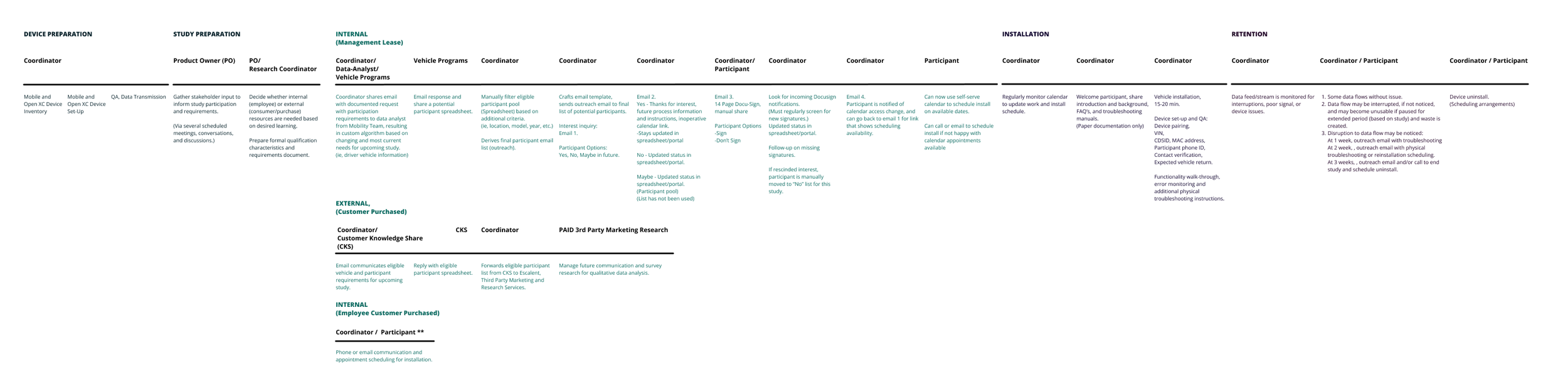
First diagram used to depict the full process of The Mobility Team’s research, coordination, and administrative efforts to select, recruit, and complete voluntary driver research studies.
Collaborative
Iteration
As I shared findings and emphasized information, we stayed aligned on the priorities, observations, and largest risk areas. These diagrams successfully depicted integration, process risks, bottle necks in data usage (and ability to access), as well as non-existent feedback loops to improve output or team service.
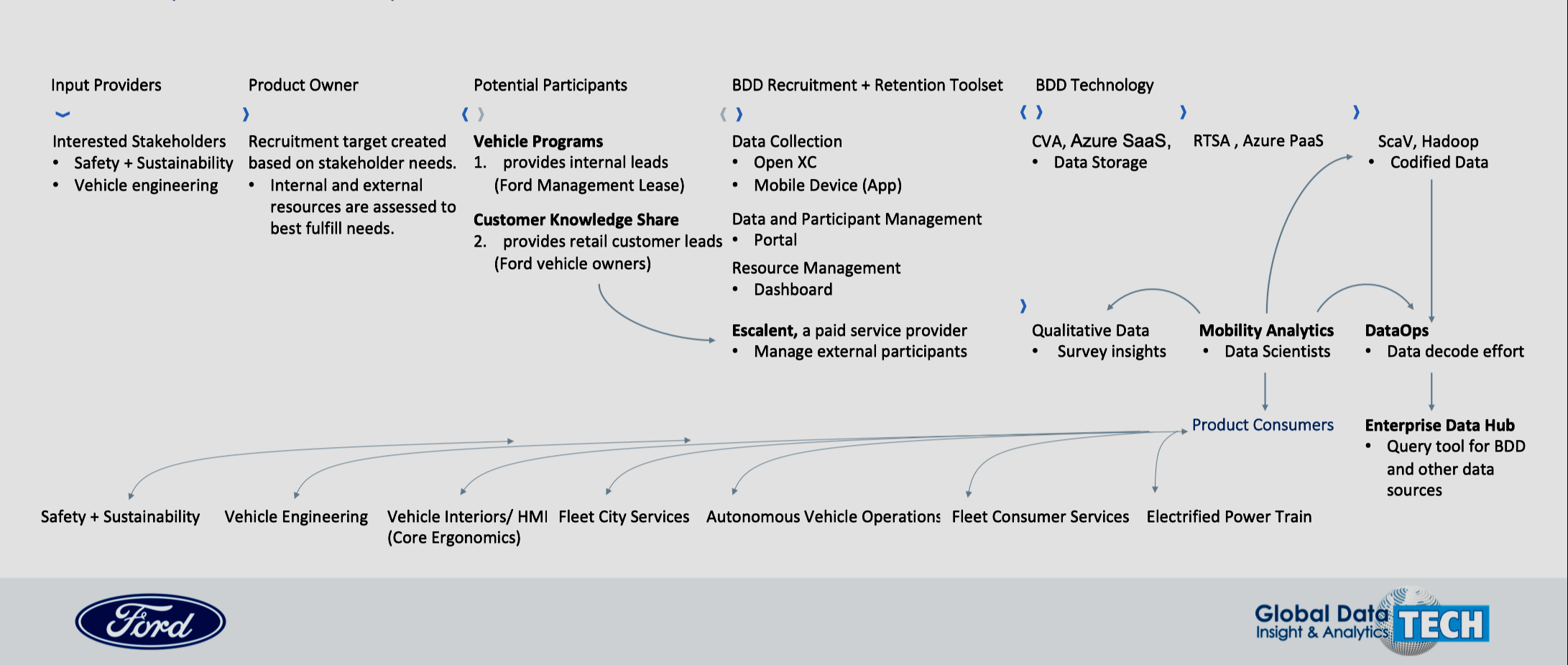
1
Diagram depicting critical interactions to source data, data flow, as well as data storage and usage.
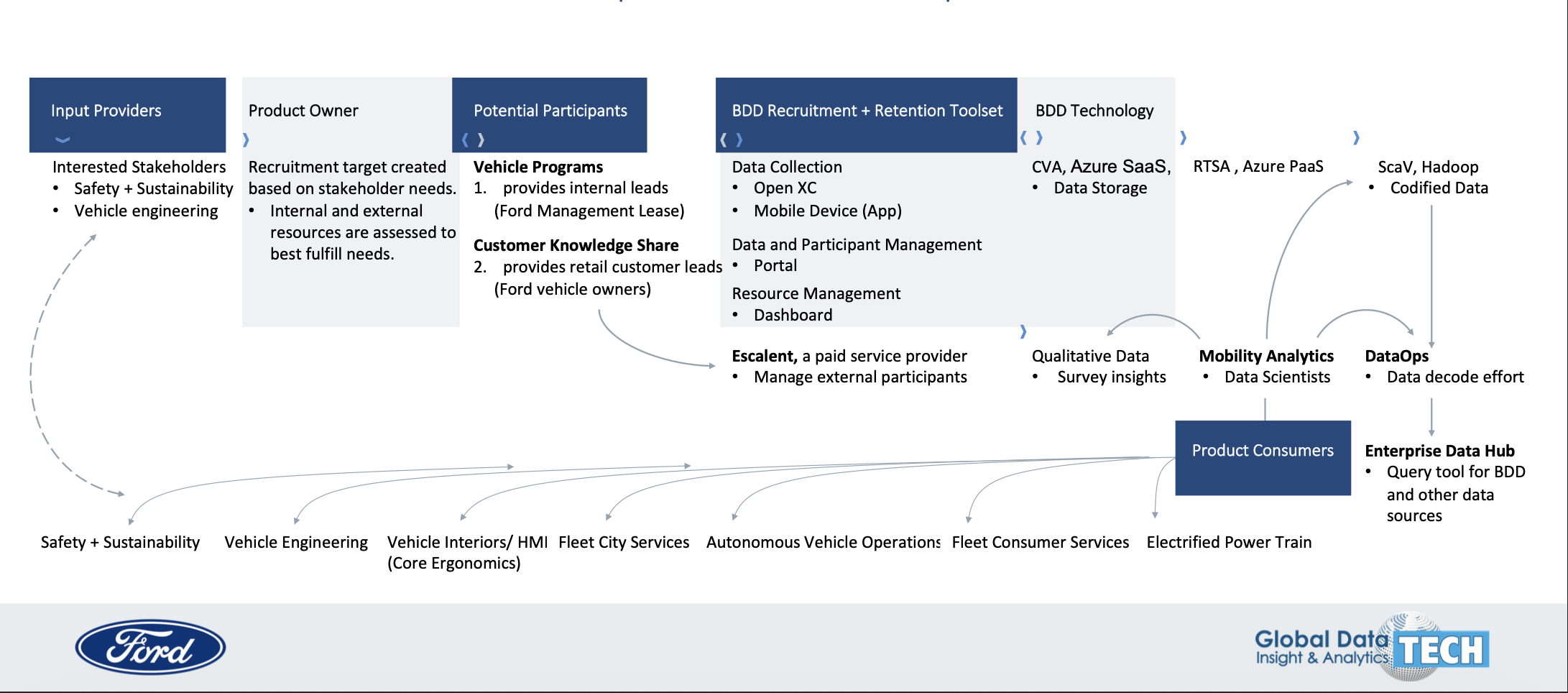
2
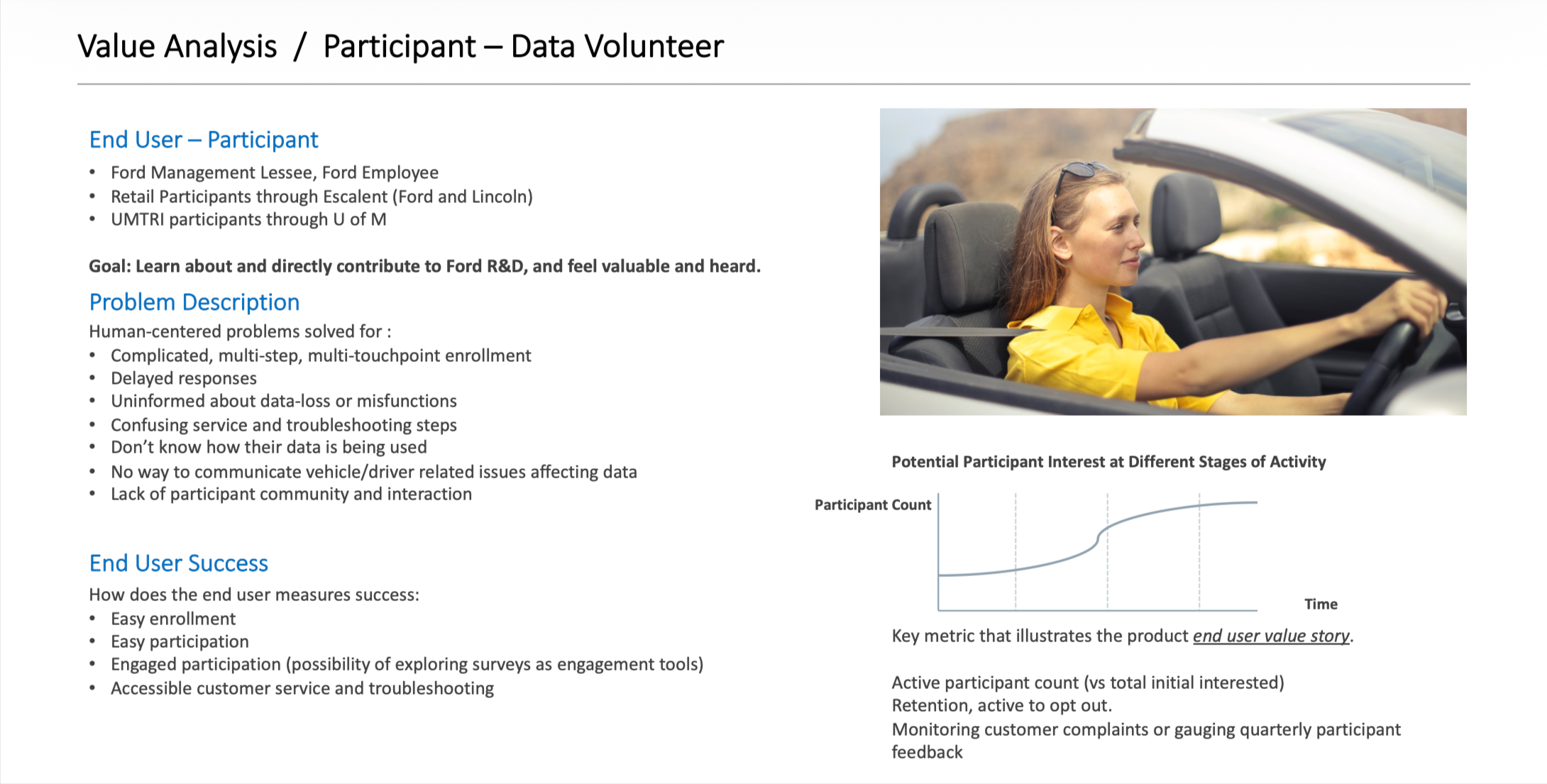
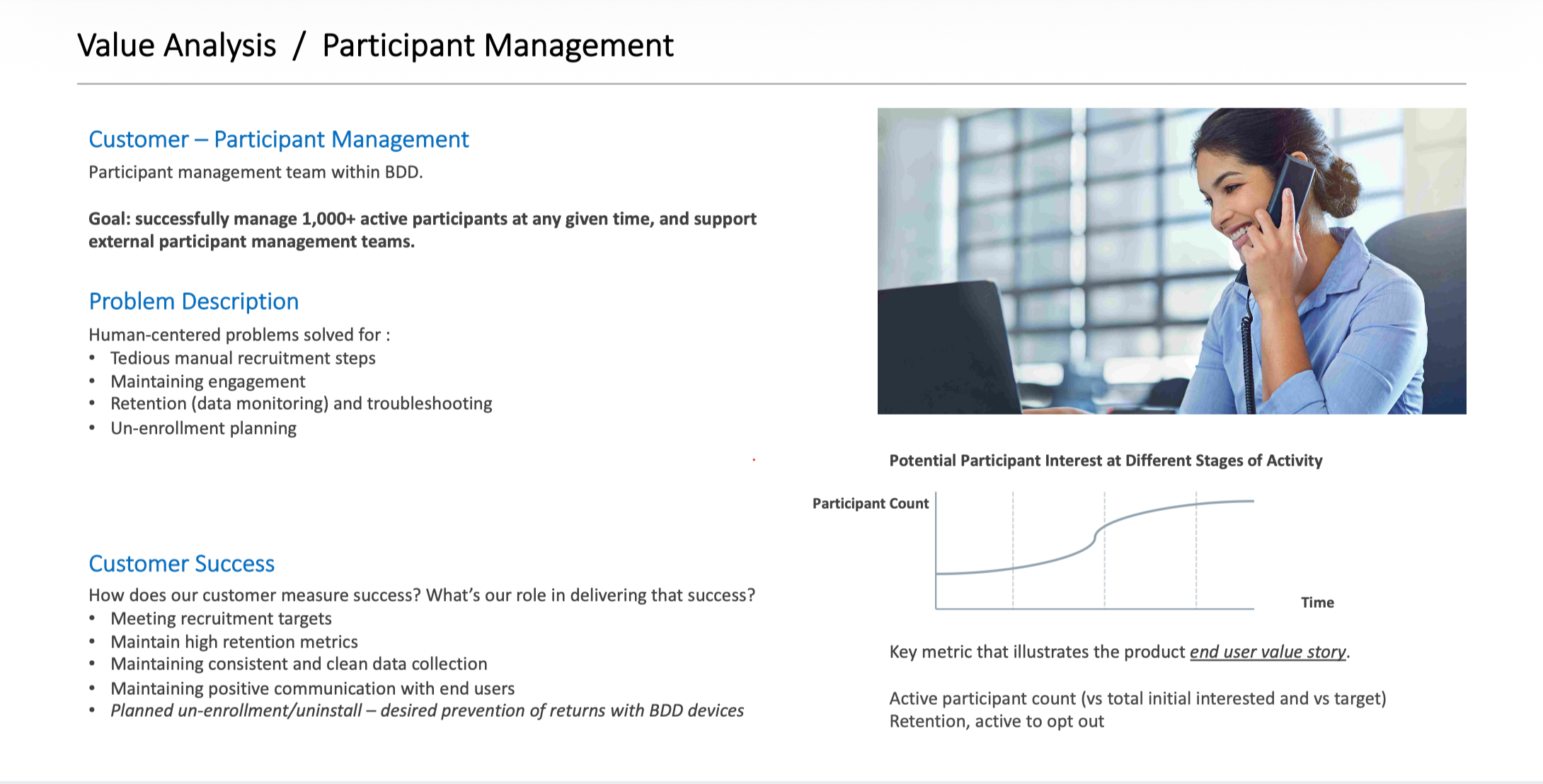
These are the humans that are most involved at each process and identified at touch-points that most derive value.
Participant Management
• The group of people who coordinate and arrange all interactions with participating data volunteers.
• They take care of recruitment, installation, and retention.
• They monitor data to insure it is being sent and received into the Mobility Experiment portal properly.
Participants
• Ford Management Lease, required to participate in a study and the choose to volunteer data to Mobility Experiment.
• External retail participants, independently purchased Ford vehicles and have no obligation to volunteer data.
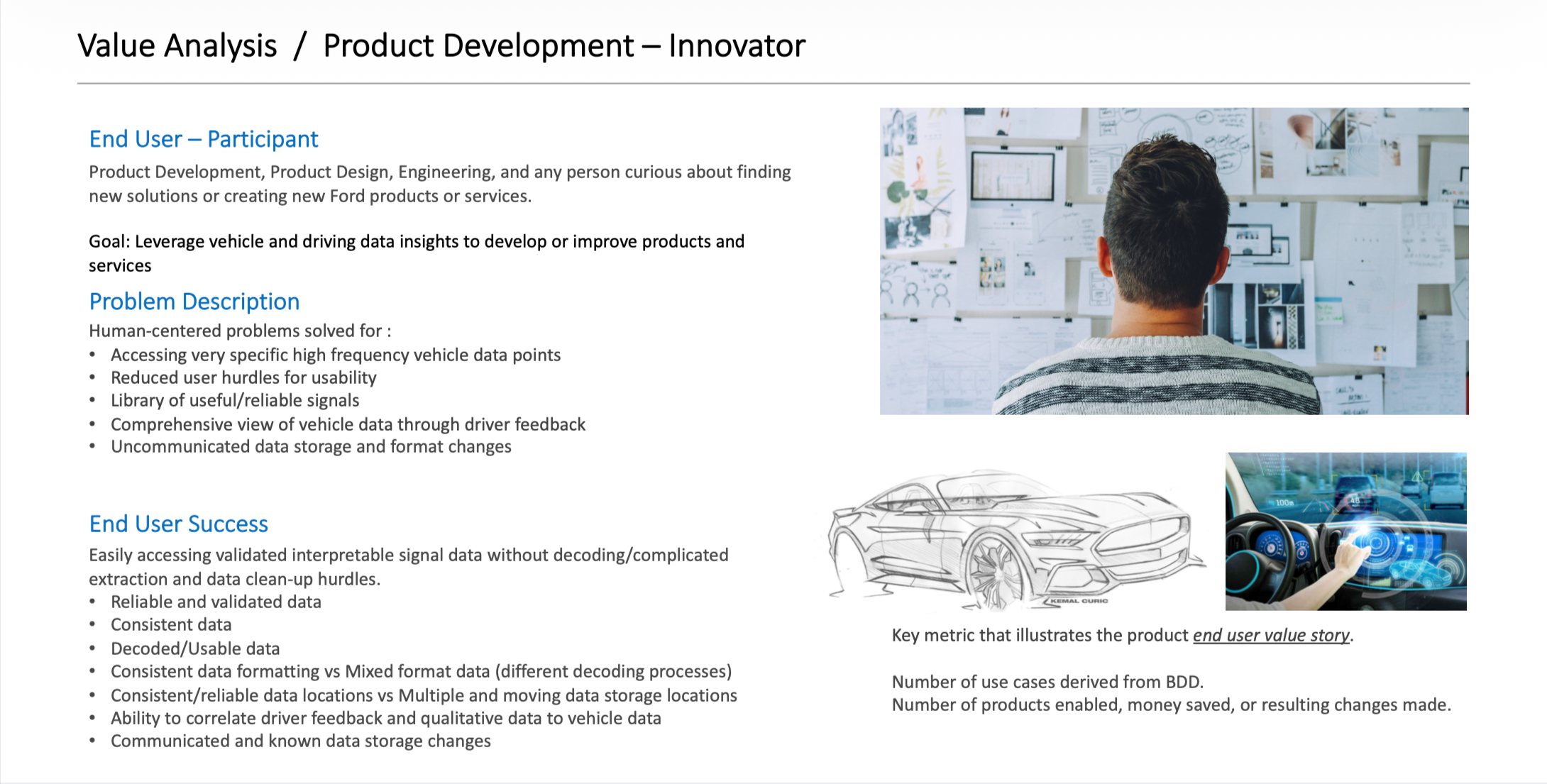
PD - Innovators
• Want to use data to help make an improvement to Ford.
• Want data to help enable new products.
• Explore the creation and improvement of Ford products.
• Curious about what they can do with existing and new data studies.
Rewritten
Product Definition
BDD provides a platform to inspire new products and services using insights from driver and vehicle data. We collect high-frequency, large number of signals from representative samples of participantsto support open-ended use case development.
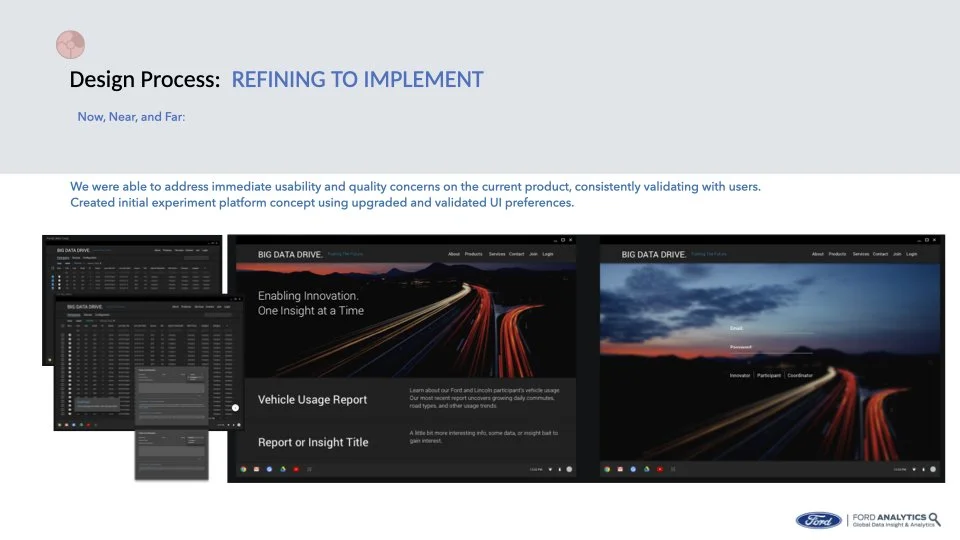
Proposed Design Options
First.
Optimize and upgrade the Mobility Experiment portal to aide Participant Managers.
Advance the participant management process to optimize recruitment, retention, uninstall and overall participant experience by increasing usability and removing unnecessary barriers and task/tool switching by maintaining processes within Mobility Experiment Portal.
Then.
Upgrade data collection to include qualitative data.
Data users will have access to driver provided input on vehicle characteristics and driving behavior. Participants will have central platform to communicate with BDD team and provide input. Survey data and vehicle data will be presented in an easy and intuitive way to data users.
We solve lack of user insights by providing survey functionality and creating a way to store feedback to help data users gather qualitative information to support existing quantitative data.
Later.
Amplify data accessibility and re-usability to enable innovation.
The new User Platform will give product and service innovators access to usable data and insights as well as offer the creation of new studies to enable innovation.
The Outcomes
The Mobility Experiment was able to show value and remain a growing product and team at Ford GDIA, with additional funding.
The Product Review process I documented was used and improved upon by other designers, as a flexible framework based on the needs of the designer in charge of the work.
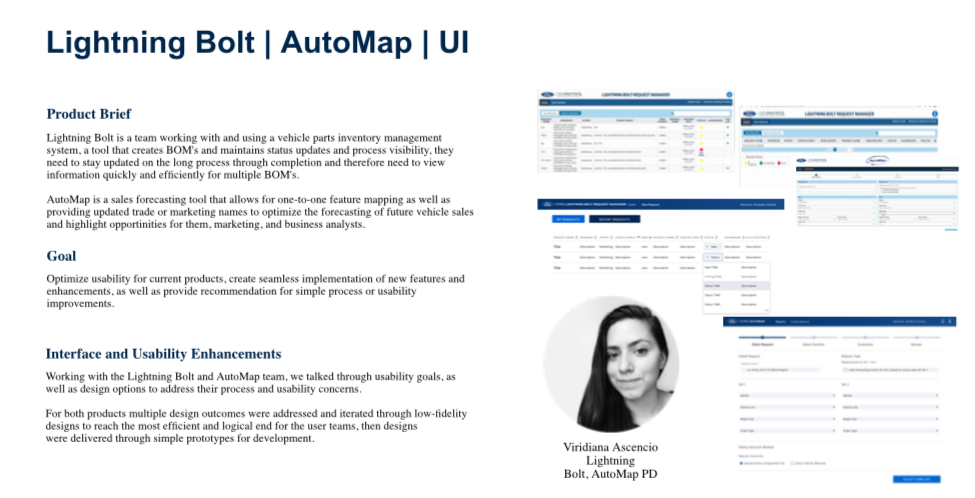
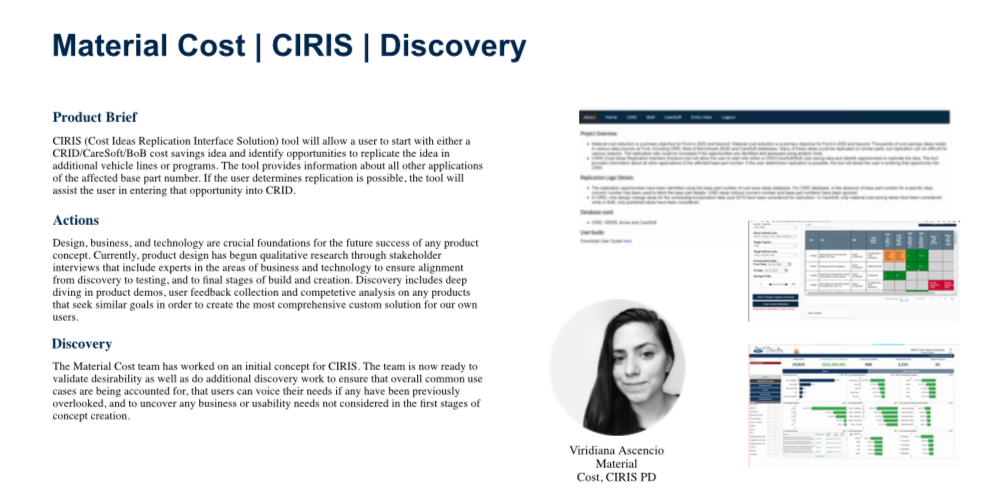
I was assigned (my agency was awarded) additional work in the Ford GDIA space based on this case study (see below).